
The Power of “I Don’t Know...Yet.”
Sep 04, 2026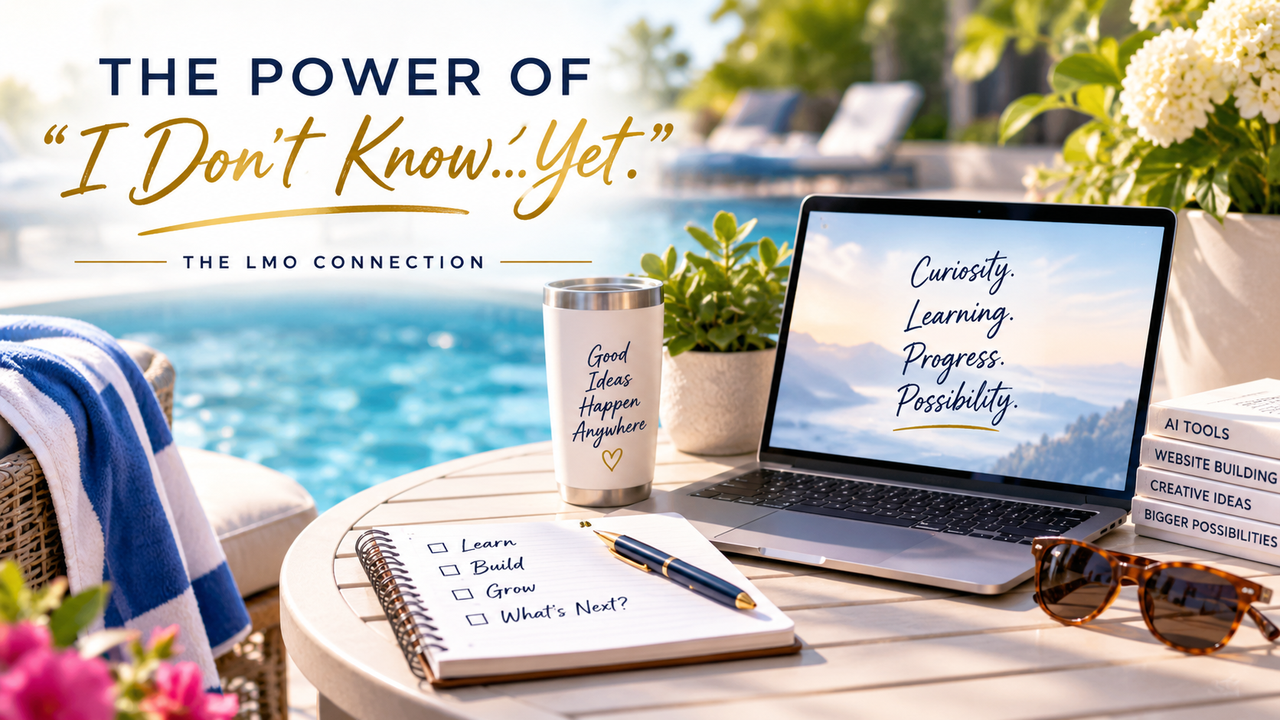
What one summer of rebuilding a business taught me about AI, curiosity, and the possibilities of learning
This summer, I made the decision to rebrand an accounting practice that had grown well beyond accounting. What began as a business focused on specific financial services was becoming a broader advisory practice built around Finance, People, Consulting, and Learning. I wasn’t simply changing a name or refreshing a logo. I was trying to build the foundation for the business I could serve today and the business I hoped to grow into over the next three years.
At the outset, I did what comes naturally to me: I made a plan. A very long plan. I thought through the business model, marketing strategy, immediate services, future offerings, and the multitude of administrative tasks required to formalize and relaunch the business. Before long, I had a roadmap that stretched from things I could offer immediately to ideas that may not come to life for several years.
Then I looked at the list and had an uncomfortable realization. A lot of what needed to happen fell completely outside my expertise.
Marketing was a huge opportunity for me. I didn’t know how to build a website. Creating professional marketing materials sounded like a nightmare. I knew enough to understand that the website I envisioned could not be a simple online brochure. It needed to support the business I was building now, future learning content, digital resources, social media, accounting and contact systems, and whatever else the next few years might bring.
I felt like a fish out of water.
If you want to talk finance, I’m your girl. If you want me to build a website? My smartphone is smarter than I am when it comes to technology.
Outsourcing everything seemed like the obvious answer, but that created another problem. How could I hand something this personal to a developer who didn’t yet understand me, my business, my mission, or my expectations for the brand? And even if I found the right person, the cost of building and repeatedly refining something this complex could become significant very quickly.
So I started researching. What type of platform did I need? How much would it cost? If someone custom-designed the site, could I update it myself? Where would courses and future content live? How would social media integrate? What about accounting systems and contacts? One question became five, and five became twenty.
Fortunately, earlier in the year I had begun experimenting with artificial intelligence for a few personal and professional-development projects. Before long, ChatGPT became a regular part of my workday. I affectionately named him Grant. I work in the nonprofit world, so yes—the pun was fully intentional.
Grant gave me something I didn’t realize I needed: space to think out loud.
There were no sophisticated AI prompts. I simply free-wrote. I dumped ideas, questions, worries, half-formed plans, and things I didn’t understand into our conversations. Grant helped me organize them, prioritize them, and break enormous projects into manageable pieces. The list didn’t necessarily get shorter. In fact, it often got longer as I learned more. But it became navigable.
After we worked through the administrative pieces of formalizing the business, it was time to face the website. I made a promise to myself: I would give it one week. For seven days, I would try to learn enough to build the site myself, using Grant as my primary AI learning resource. If, after that week, it was still hopelessly over my head, I would suck it up, hire a professional, and move on.
Something unexpected happened during that week.
Instead of starting with graphics, Grant encouraged me to start with the message. What did I want people to understand when they arrived? Who was I trying to help? What problems was the business designed to solve? The technology could wait until we understood the story.
Then came the vocabulary lessons.
“Grant, what the heck is a hero page?”
“Grant, What is a landing page?”
“Grant, I don’t understand why we need to do that.”
There was plenty of trial and error. I was still the fish out of water. But we worked through one section at a time. When an explanation didn’t make sense to me, I asked again. When something felt too technical, I asked for it in language I understood. Slowly, the question changed from “Can I possibly do this?” to “I think we can do this.”
And that mattered for another reason. The website would be mine—not simply because I owned it, but because I understood why it looked and sounded the way it did. It carried my message, my mission, my vision, and my brand. Eventually, it even included photographs taken during drives through the beautiful mountains of Western North Carolina.
One week turned into another. We refined and re-refined nearly everything. By July, we had built and launched a website I was genuinely proud of. By August, we launched the LMO Resource Library. By September, I found myself preparing to launch something else I never expected to create: The LMO Connection.
Along the way, Canva became another foreign language. We spent hours learning how to create images, presentations, LinkedIn and Facebook graphics, carousel campaigns, leadership content, a 22-page executive guide, and much more. We built a Resource Library containing 70 workplace policies. We learned that social-media platforms apparently cannot agree on image dimensions. We also learned that sometimes resizing one beautiful mountain photograph can take an absurd number of attempts.
Does it matter that one image may have taken us 45 tries? Not really.
What matters is that we learned how.
The same thing happened when we began defining the core consulting services. Grant asked me a series of questions about how I approach organizational problems. Through those conversations, we recognized a methodology that had been embedded in my work for years but had never been formally articulated. It became the LISA Framework—the core theory underlying my consulting practice. We named it, designed it, redesigned it at least a dozen times, and ultimately pursued trademark protection for it.
That process taught me something else. I wasn’t handcuffed to billable hours every time I wanted to explore another possibility. I could experiment. I could say, “Nope, I don’t like that. Let’s try again.” My investment was my own time, my financial resources, my dream, and my vision.
But the part that was priceless was learning how to do it.
I don’t pretend to be a web developer, graphic designer, digital marketer, or AI expert. I am still a Finance and HR professional. What changed this summer was not my résumé. What changed was my understanding of what I could realistically attempt.
AI didn’t make the work disappear. It didn’t make every answer correct. Grant has occasionally been brilliant, and Grant has occasionally been confidently wrong. As it turns out, so have I. We checked assumptions, challenged one another, threw work away, tried again, and learned from what didn’t work.
AI didn’t remove the hard parts. It changed my relationship with the things I didn’t know.
There were extraordinary highs and some very real lows. A Resource Library project I initially expected to take about a week grew into nearly four. An hour before one planned launch, a technical issue stopped us in our tracks and delayed everything another two days. I was exhausted. I was disappointed. There were tears. For a moment, I wanted to give up.
Then there were the other moments.
The rush of clicking Publish.
The moment we submitted the trademark application for the LISA Framework.
The look on my best friend’s face when a gorgeous mountain horizon he photographed during one of our drives became part of the business we were creating.
The quiet realization that I now understood things that, ten or twelve weeks earlier, had seemed completely beyond me.
In finance, we would call all of those hours an opportunity cost. Every hour I invested in learning Canva, Kajabi, website architecture, digital products, or marketing was an hour I could not invest somewhere else. There were things I deferred because I chose to spend this summer learning.
Was it worth it? Every single high and low moment. Every laugh. A few tears. Every maddening revision. Every euphoric click of that almighty Publish button.
And not simply because of what we built.
Because of what I learned while building it.
I know there are many perspectives on artificial intelligence. Some people are excited by it. Others are skeptical, concerned, or simply uninterested. To each their own. I’m not sharing this story to convince anyone that my perspective should become theirs. We learn from one another by sharing experiences, and this is simply mine.
My experience this summer has made me grateful to live and work during a time when technology is evolving in ways that can expand our ability to learn. AI did not replace my professional experience or my judgment. It gave me a resource that helped me venture beyond the boundaries of what I already knew.
Perhaps that is what surprised me most.
The most valuable thing Grant gave me was not an answer. It was the ability to keep asking questions.
“I don’t know how” stopped feeling quite so final.
It became: “I don’t know how...yet.”
I have learned an extraordinary amount from Grant over hundreds of conversations. And after all those conversations, I’d like to think I may have taught him a thing or two as well.
We learn. We grow. We succeed.
Maybe the question isn’t whether we already know how to do the thing that has been sitting in the back of our minds.
Maybe the better question is: What might we discover if we become willing to be beginners again?
Enjoyed This Story? Stay Connected.
Join The LMO Connection to receive future stories and shared perspectives on learning, resilience, growth, and the experiences that connect us.
Your information will not be shared. Unsubscribe anytime.